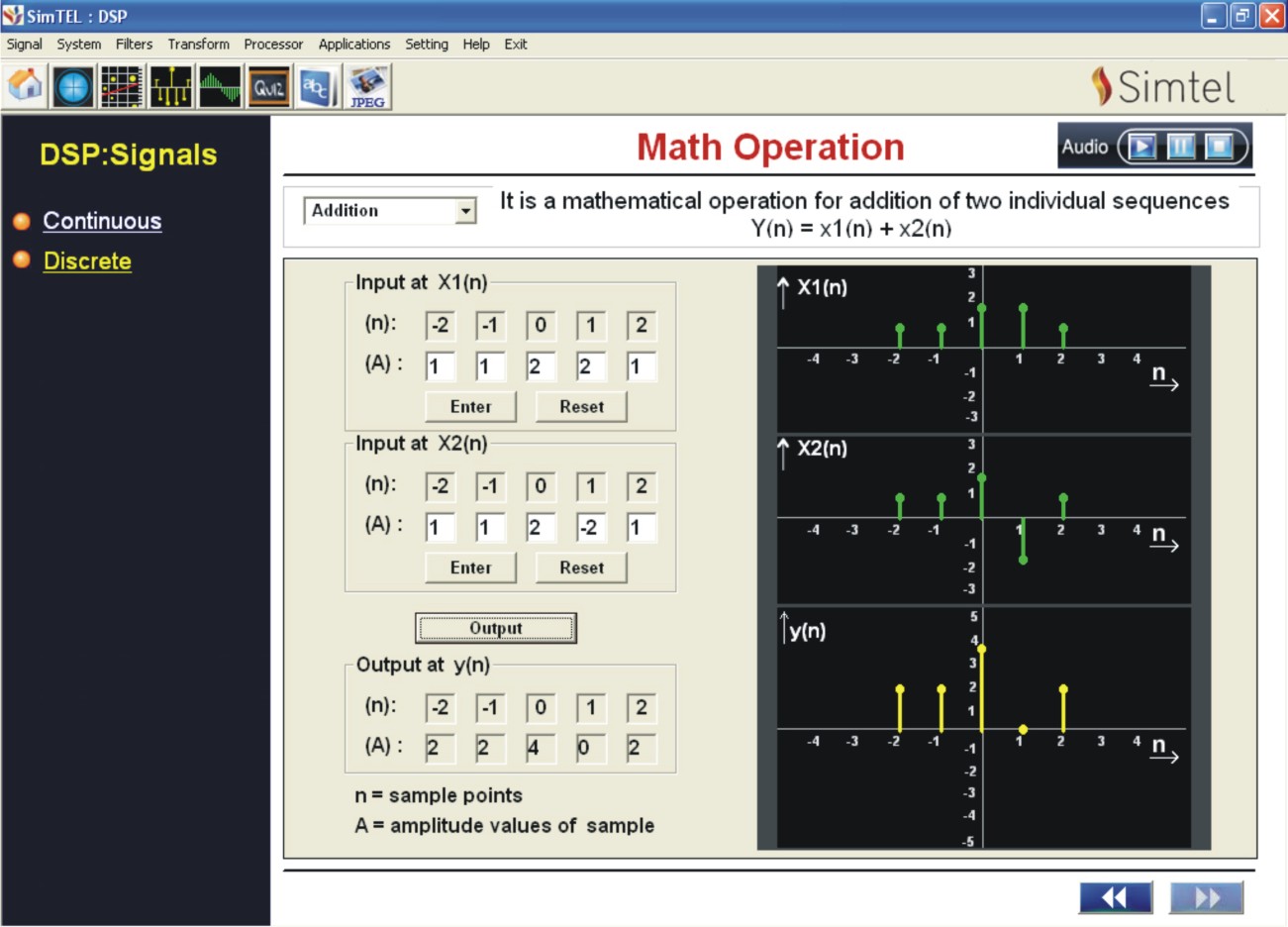
Simtel Digital Signal Processing Software, Simtel DSP, is a technology learning software designed to explain the concepts of Digital Signal Processing. With the help of Simulation Software, it offers real time understanding of digital signal processing algorithms and a better visualization of signals and their applications through simulation. Simtel DSP is an attempt to transform all the mathematical details into a lucid graphical explanation of the topics covered under digital signal processing (DSP) syllabus. Interactive Simulations are provided for complex principles and theorems where the user can experiment with his own choices of signals and systems. Simtel DSP is a digital learning software to provide and explain signal analysis, study fast fourier transform, study discrete fourier transform, study convolution, study image compression, study z-transform, image processing, filter design, FIR Filter, IIR Filter etc. This DSP digital signal processing software helps users understand important concepts through simulation-based learning.
Features
- Signals: Signals, Math Operations, System, Sampling, Quantization, Reconstruction
- Filter: Convolution, Correlation, FIR, IIr
- Transformation: Fourier Series, Fourier Transformation, DFT, FFT, Z-Transform
- Processors: Embedded System, DSP Processor, TMS 320C6713, Analog Processor
- Applications: Image Processing, JPEG image Compression, Telephone, Medical
The digital signal processing applications covered by the software help users understand how DSP concepts are used in image processing, JPEG image compression, telephone systems, and medical applications. The software provides practical exposure to Digital Signal Processing (DSP) concepts through interactive simulations and helps users understand different digital signal processing applications.
Applications
The Digital Signal Processing (DSP) software provides practical learning of digital signal processing applications across various fields. It helps users understand how DSP digital signal processing techniques are used for analyzing, processing, and transforming signals in real-world systems.
Key digital signal processing applications covered by Simtel DSP include:
- Image Processing: Understand signal processing techniques used for image enhancement and analysis.
- JPEG Image Compression: Learn how digital signals are processed for efficient image compression.
- Telephone Systems: Explore the use of digital signal processing in modern telephone and communication systems.
- Medical Applications: Understand how digital signal processing (DSP) is applied to process and analyze signals in medical systems.
These applications help learners connect theoretical digital signal processing concepts with practical applications in communication, image processing, and medical technology.
Why Choose Simtel Digital Signal Processing?
Choose Scientech Digital Signal Processing software for an interactive and practical approach to learning Digital Signal Processing (DSP). The software helps learners understand complex concepts through graphical simulations, making topics such as signal analysis, Fourier Transform, DFT, FFT, Z-Transform, convolution, and filter design easier to visualize. It also covers important digital signal processing applications in areas such as image processing, JPEG image compression, telephone systems, and medical technology. With its simulation-based approach, Simtel helps students connect DSP digital signal processing theory with practical applications and develop a better understanding of real-world signal processing systems.
- Practical Learning: Simtel DSP provides an interactive way to understand Digital Signal Processing (DSP) concepts through simulation.
- Easy Visualization: Complex digital signal processing algorithms and mathematical concepts are presented through clear graphical simulations.
- Wide Range of Applications: Explore important digital signal processing applications including image processing, JPEG image compression, telephone systems, and medical applications.
- Interactive Simulations: Experiment with different signals and systems to understand how DSP digital signal processing techniques work in practical situations.
- Comprehensive Learning: Study important DSP topics such as Fourier Series, DFT, FFT, Z-Transform, convolution, FIR, and IIR filters.
- Application-Oriented Understanding: The software connects digital signal processing (DSP) theory with practical applications, helping learners develop a better understanding of signal analysis and processing.
FAQs
What is Digital Signal Processing?
Digital Signal Processing (DSP) is the use of digital techniques and algorithms to analyze, modify, filter, and process signals such as audio, images, and communication signals. It helps convert raw signal data into useful information for different applications.
What are the main applications of Digital Signal Processing?
Digital signal processing applications include image processing, audio and speech processing, telecommunications, medical technology, radar systems, and JPEG image compression. DSP is widely used wherever digital signals need to be analyzed or improved.
How does DSP Digital Signal Processing work?
DSP digital signal processing uses mathematical algorithms to process digital signals. Common techniques include sampling, quantization, filtering, convolution, Fourier Transform, DFT, FFT, and Z-Transform.
What is the difference between analog and Digital Signal Processing?
Analog signal processing works with continuous electrical signals, while Digital Signal Processing (DSP) works with signals represented in digital form. Digital processing allows signals to be analyzed, stored, filtered, and modified using software or digital processors.
Why is Digital Signal Processing important for students and engineers?
Digital Signal Processing helps students and engineers understand how real-world signals are analyzed and processed in modern electronic and communication systems. Learning DSP concepts and digital signal processing applications provides a foundation for working with technologies such as telecommunications, image processing, embedded systems, and medical equipment.